
The Space Between Us
Essays
In many conversations there is a brief moment just before something becomes clear.
A thought is sensed but not yet fully articulated. Someone searches for words. The group leans in. Several interpretations hover in the air at once.
This brief space — where meaning is present but not yet defined — is what we call the threshold.
In our Between-Us groups we have begun to notice how often the most significant moments occur in this liminal interval. It is not so much that insights suddenly arrive. Rather, there is often a shared recognition when something true has appeared between us. The recognition itself may be as important as what is spoken, creating a subtle alignment that allows the exploration to move further.
Until recently we focused mainly on the conditions that allow relational intelligence to arise: autonomy, vulnerability, honesty, integrity, trust — listening without conceptualising, and the interplay of risk, resonance and coherence.
Over time another element has become visible: the importance of allowing this unfinished moment to remain open long enough for something new to take shape.
The Liminal Moment
In a typical conversation people exchange ideas. Each participant explains what they already think, and the group gradually sorts those positions into agreement or disagreement.
Something quite different begins to happen when participants begin speaking from the edge of what they are sensing rather than from fully formed positions.
A shared curiosity shapes the atmosphere of the room. Attention becomes both focused and relaxed — alert to what is being said while remaining open to what might still emerge.
Gradually something else becomes noticeable.
A subtle field of attention forms between the participants.
Thoughts appear that no one feels they fully own. Questions arise that probe beneath what has already been said. Insights surface that could not easily have been produced by any single individual. When something true is spoken, a quiet recognition moves through the group.
If the moment is defined too quickly, the conversation often collapses back into familiar patterns of explanation and opinion.
Protecting the Space of Emergence
Over time we have begun to recognise the conditions that help protect this delicate space.
Autonomy matters. Each person must feel free to speak from their own experience rather than conforming to a group narrative.
Vulnerability matters. When participants risk revealing something genuine, the field deepens.
Integrity matters. The group must trust that what is spoken is offered honestly.
Certain signals often indicate that the group is approaching this edge:
• the pause before someone speaks
• heightened attention as someone searches for words
• several interpretations coexisting at once
• a shared sense that something is present but not yet fully clear
Working with these moments often means allowing:
• silence
• unfinished statements
• questions without immediate answers
• multiple perspectives to remain alive
Rather than obstructing understanding, these conditions allow a deeper pattern to appear.
A Different Kind of Intelligence
Experiences like these suggest something that challenges a deeply ingrained assumption.
We tend to think of intelligence as something individuals possess.
Yet in these conversations intelligence sometimes appears between people rather than inside any one of them.
Insights emerge that no single participant planned. Questions arise that redirect the entire group. Understanding forms as a shared event.
Relational intelligence cannot be owned or stored. It exists only within living relationships and disappears when those relationships collapse back into hierarchy, performance or fixed positions.
Cultivating spaces where this kind of intelligence can arise therefore becomes more than an interesting conversational experiment.
It becomes a way of protecting a form of knowing that modern systems often overlook.
And in a time when intelligence is increasingly imagined as something that can be packaged, marketed and used to control, this discovery points in a different direction.
Some forms of intelligence exist only in the space between us.
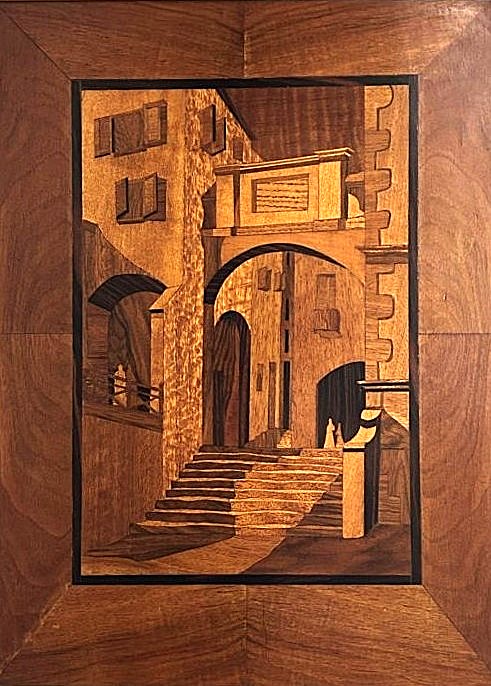
Image: Marquetry panel made by my father: N Mitchell
Living on the Threshold
Sign up for updates, news, reflections, and poems, as well as occasional book or article recommendations from the edges of philosophy, mysticism, and consciousness. After signing up, you’ll receive a welcome email — please click the link to confirm your subscription (and check your spam folder if you don’t see it).


Newsletter Sign-Up